- Beyond Syntax
- Posts
- 3 Letters That Redefined AI
3 Letters That Redefined AI
NLP (Part 1)

John Reynolds
September 05, 2024
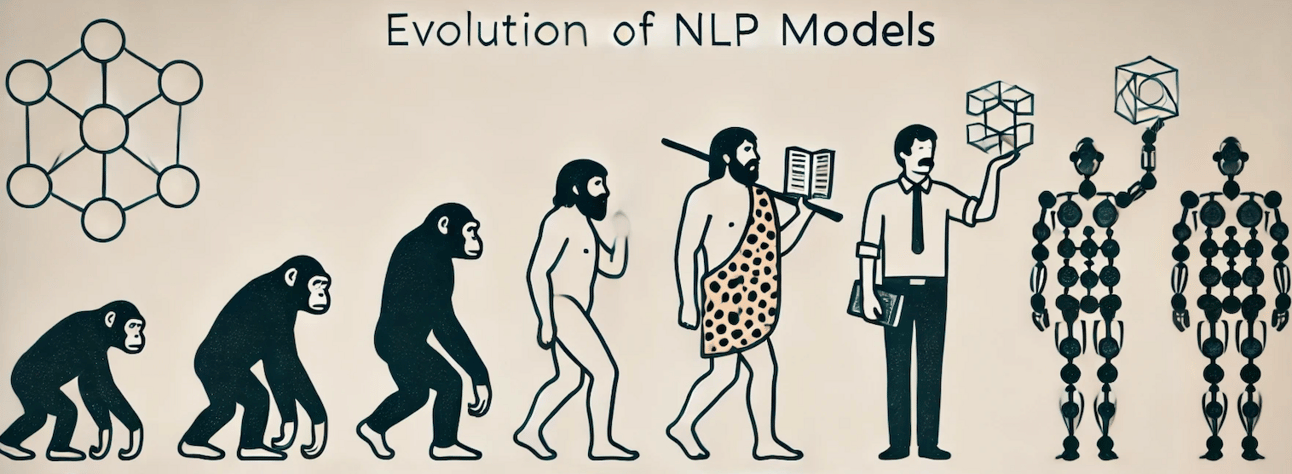
Natural Language Processing (NLP) represents our ongoing quest to teach machines to understand and generate human language.
The journey—from basic text manipulation to the advanced models of today—can be likened to how a child gradually learns to recognize and categorize the world around them, developing more complex understanding with each step. By using this analogy, we can explore the key milestones in NLP’s development, showing how each stage has built on the last, leading us to the powerful Large Language Models (LLMs) that have redefined the future of AI.
Imagine guiding a young child through the process of identifying different fruits. You might start with simple rules—"If it’s round and red, it’s an apple." But as the child learns more, they start noticing patterns, exceptions, and contexts that deepen their understanding. This mirrors how NLP evolved from rigid, rule-based systems to models capable of grasping the complexities and nuances of human language.
From Rules to Understanding
In the 1950s and 60s, NLP’s earliest systems were based on strict, rule-based approaches, much like a child learning basic, inflexible rules to identify fruit. These systems operated on predefined logic, processing language through a set of hardcoded rules. While this approach was a logical starting point, it was inherently limited—struggling with anything outside its programmed scope.
Rule-based systems are like a chess game. The AI makes decisions based on a fixed set of rules and logic. For example, if the opponent’s queen threatens the king, the AI will move the king to safety because that's what the rules dictate. It doesn't learn or adapt from previous games; it strictly follows the instructions given by its developers.
The image in Example 1, diagrams the four core steps in a rule-based NLP approach:

Example 1: Rule Base Approach
Rule Creation: Develop domain-specific linguistic rules.
Rule Application: Apply these rules to input data.
Rule Processing: Analyze data and extract information based on rules.
Rule Refinement: Continuously improve and update rules based on feedback.
An example of this early stage is the Georgetown-IBM experiment in 1954, where a system successfully translated over 60 Russian sentences into English. This was a remarkable achievement for the time, but it also highlighted the rigidity of rule-based systems. The translation process relied on a narrow, controlled vocabulary and could not adapt to the complexities of natural language, such as idioms, nuances, or context.

Example 2: Georgetown-IBM experiment
To understand why this approach was limiting, consider teaching a child that “round and red” means “apple.” This rule works until the child encounters a green apple or a red cherry. Similarly, early NLP systems could not handle variations in language—they were only as good as the rules they were given.
As researchers began to see the shortcomings of this approach, they turned to more sophisticated theories. Noam Chomsky’s introduction of transformational grammar in the 1950s marked a pivotal shift. Transformational grammar suggested that language could be understood through deep structures (the underlying meaning of sentences) and surface structures (the actual wording). This was akin to teaching a child that “the apple is red” and “the red apple” have the same meaning, despite the difference in word order.

Example 3: Transformational grammar
Around the same time, Joseph Weizenbaum’s creation of ELIZA in 1966 provided an early glimpse into human-computer interaction. ELIZA was a simple program designed to mimic a psychotherapist by rephrasing the user’s statements. While ELIZA could engage in what seemed like a conversation, it didn’t understand the content—it merely followed a script based on pattern matching. This is like a child who can repeat phrases but doesn’t grasp their meaning, demonstrating both the potential and limitations of early NLP.

Example 4: ELIZA
The Rise of Statistical Models
As the limitations of rule-based systems became clear, the 1980s and 90s saw a significant shift towards statistical methods in NLP. Imagine the child now recognizing patterns across different fruits, understanding that while most round, red fruits are apples, some might be cherries. This shift represents the introduction of probabilistic thinking, where models began to consider likelihoods rather than relying solely on fixed rules.
Statistical models, such as Hidden Markov Models (HMMs) and N-grams, became foundational during this period. HMMs were particularly effective for tasks like speech recognition, where the model needed to predict the likelihood of sequences of words based on probabilities. For example, in speech-to-text systems, HMMs would analyze the acoustic signal and predict the most likely sequence of words—much like predicting that “I scream” is more likely to follow “You scream” than “Ice cream.”
The diagram in Example 5, shows a HMM, where each circle represents a state (S1,S2,S3), and the arrows between them show the probabilities of transitioning from one state to another.

Example 5: HMM
The states generate observable outputs (O1,O2,O3), like words or phonemes, which are the actual signals we detect.
N-grams, on the other hand, were crucial in language modeling and machine translation. By analyzing the probability of sequences of words (unigrams, bigrams, trigrams), these models could predict the next word in a sentence. This approach allowed NLP systems to generate more fluent and contextually appropriate translations and text. For example, in the sentence “This is a sentence,” a bigram model would analyze word pairs like “This is” and “is a,” while a trigram model would consider triples like “This is a.”

Example 6: N-grams
These statistical methods marked a fundamental shift in NLP. Instead of relying on deterministic rules, models could now learn from data, making them more flexible and better suited to handle the variability of human language.
Machine Learning Takes the Stage
With the turn of the 21st century, machine learning began to revolutionize NLP. Instead of relying on manually crafted rules, models could now learn directly from data—much like a child who, through experience, learns to distinguish between a green apple and a pear by considering additional context clues.
Support Vector Machines (SVMs) and decision trees were among the early machine learning models that excelled in tasks like text classification and sentiment analysis. SVMs, for example, work by finding the optimal boundary (or hyperplane) that separates different classes in the data. Imagine separating fruits based on features like color and shape—SVMs would find the line that best distinguishes apples from oranges, even in complex scenarios where the differences aren’t obvious.

Example 7: N-grams
Decision trees, on the other hand, classify data by making decisions based on the input features, much like a child deciding whether a fruit is an apple or a pear by asking a series of questions—“Is it red?” “Is it round?” Each question narrows down the possibilities, leading to a final decision.
These models demonstrated the power of data-driven learning, allowing NLP systems to adapt to the nuances of human language and perform tasks that were previously difficult with rule-based systems.
Deep Learning and the Power of Word Embeddings
The 2010s marked the rise of deep learning, which propelled NLP into a new era. Deep learning models, particularly neural networks, were capable of capturing complex, non-linear relationships within data—much like a child recognizing that apples and pears are related but distinct.
A key innovation during this time was the introduction of word embeddings, with models like Word2Vec transforming how words were represented. Instead of treating words as isolated entities, embeddings captured the semantic relationships between them by mapping words to vectors in a continuous space. For instance, in this vector space, “king” and “queen” might be close together because they share similar semantic properties, while “king” and “apple” would be farther apart.

Example 8: Embeddings
Word embeddings allowed NLP models to understand language on a deeper level, capturing the subtle relationships between words. This was a significant leap forward from earlier models, enabling systems to generate text that was more contextually appropriate and semantically rich.
The Transformer Revolution
As the child’s understanding becomes more sophisticated, they can quickly scan a basket of mixed fruits, identifying each one by considering both individual details and the overall context. This ability is mirrored in the Transformer architecture, introduced in 2017, which revolutionized NLP by processing words in parallel and capturing context more effectively than ever before.

Example 9: Transformer Architecture
The Transformer’s self-attention mechanism allowed models to weigh the importance of each word in a sentence relative to others, enabling them to grasp long-range dependencies and nuanced meanings. For example, in the sentence “The cat sat on the mat because it was tired,” the model can recognize that “it” refers to “the cat,” even though several words separate them. This parallel processing and attention to context made Transformers incredibly powerful for tasks like translation, summarization, and text generation.
The introduction of Transformers set the stage for pre-trained models like BERT and GPT, which leveraged large datasets to learn general language patterns. These models could then be fine-tuned for specific tasks, making them versatile and highly effective across a wide range of applications.
The Era of Large Language Models
Finally, after years of learning and refinement, the child becomes an expert—capable of identifying, describing, and even predicting the characteristics of fruits in various contexts. This stage reflects the development of Large Language Models (LLMs) like GPT-3 and GPT-4, which have taken NLP to unprecedented heights.

Example 10: BERT / GPT
LLMs are trained on vast datasets and leverage the Transformer architecture to capture complex linguistic patterns with remarkable accuracy. For example, GPT-3 can generate human-like text by predicting the next word in a sequence, drawing on the vast amount of data it has been trained on. This allows it to produce coherent and contextually appropriate responses to a wide range of prompts, from writing essays to answering questions.
Similarly, BERT’s bidirectional approach enables a deeper understanding of context, as it considers both the words before and after a given word in a sentence. This makes BERT particularly powerful for tasks like question answering and sentiment analysis, where understanding context is crucial.
The Future of NLP and LLMs
The evolution of Natural Language Processing (NLP) from basic rule-based systems to advanced Large Language Models (LLMs) like GPT-4 reflects the rapid progress in AI’s ability to achieve natural language processing. Each stage—from rigid rules to flexible, data-driven models—has been a crucial step forward, enabling more accurate and nuanced language processing.
“LLMs aren’t just the biggest change since social, mobile, or cloud–they’re the biggest thing since the World Wide Web.”
These models represent the culmination of decades of innovation in NLP, pushing the boundaries of what machines can achieve with human language. While challenges remain in translating their capabilities into practical applications, the evolution of LLMs has undeniably expanded the possibilities of AI, setting the stage for future advancements.
Subscribe for Part 2, focused on the LLMs
References
Sharma, R. (2023). Mastering NLP from Foundations to LLMs: Apply advanced rule-based techniques to LLMs and solve real-world business problems using Python. BPB Publications.
Dey, A. (2023). Mastering Large Language Models with Python: Unleash the Power of Advanced Natural Language Processing for Enterprise Innovation and Efficiency Using ... Models (LLMs) with Python (English Edition). BPB Publications.
Reply